Can foreigners get a mortgage in the USA?
Yes, absolutely. There are many lenders with foreign national programs helping international buyers finance U.S. property. The terms and underwriting differ a little, but specialist lenders offer mortgages built for foreigners with no SSN, U.S. credit history, or U.S. income. If you have proof of funds for your down payment, a qualifying property, and a clean paper trail, approval is surprisingly straightforward with the right guidance.
You will not qualify for a conventional mortgage through a traditional retail bank like Wells Fargo or Bank of America, but that is not a barrier. Foreign national loans are designed around the things that trip up non-resident borrowers, looking instead at your foreign income and assets, your bank statements, or the rental income of the property you are buying.
Resident vs foreign national mortgages, key differences| Feature | U.S. resident mortgage | Foreign national mortgage |
|---|
| SSN required | Yes | No |
| U.S. credit score | Required | Not required |
| Income documents | W-2s, tax returns | Foreign bank statements, proof of funds |
| Loan type | Conventional or FHA | Foreign national / Non-QM |
| Down payment | As low as 3% to 5% | Typically 25% to 30% |
| Interest rates | Lower with strong credit | Slightly higher, risk-tiered |
Who qualifies as a foreign national?
For U.S. mortgage lending, a foreign national is someone who is not a U.S. citizen, does not pass the substantial presence test, and has no permanent resident status (no green card).
That typically includes citizens of other countries living abroad, and non-residents on tourist or temporary visas. This status is not a barrier, it simply means you apply through a lender with a foreign national program. For the bigger picture, see my guide on how foreigners buy U.S. property.
The types of foreign national mortgage
There are essentially three options to suit different types of borrower and type of purchase.
1. Conventional loans use your personal income and credit, usually from your home country.
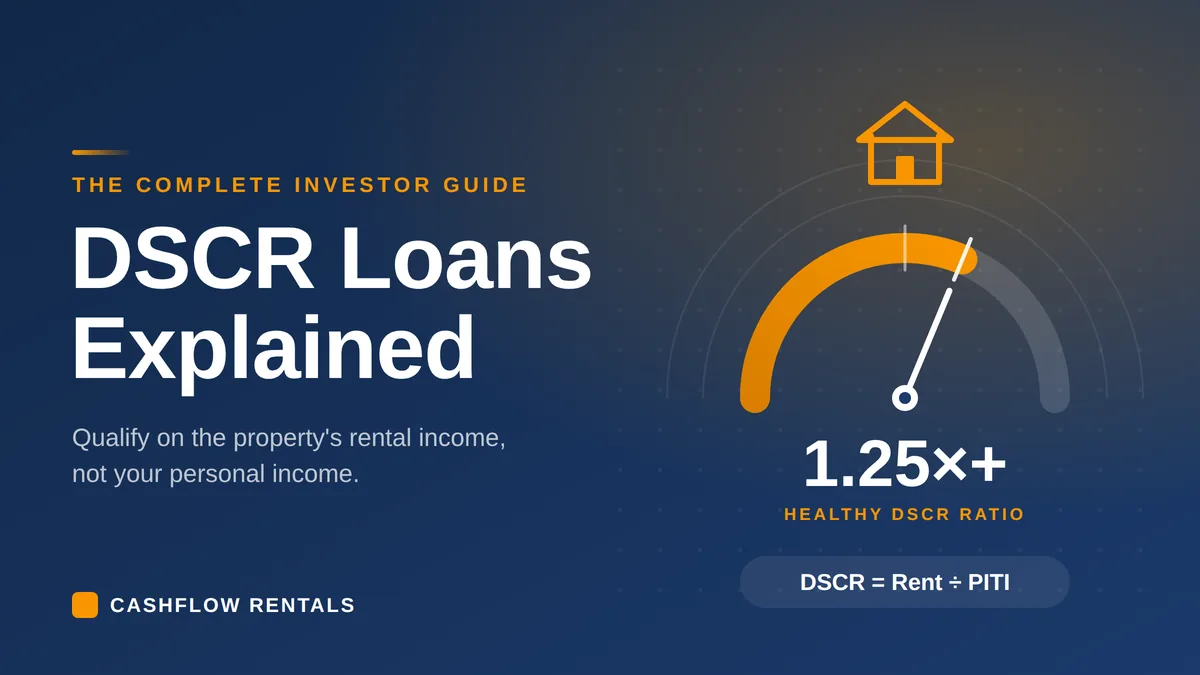
2. A foreign national DSCR loan uses the property's rental income rather than your personal income, which is ideal for rentals.
3. ITIN loans suit borrowers who already have U.S. income and two years of U.S. tax returns.
Foreign national mortgage loan comparison| Loan type | Ideal for | Qualifies on | Typical lenders |
|---|
| Conventional | Vacation and second homes | Personal income, assets, and credit | HSBC, First American Bank, Quontic, LendSure |
| DSCR | Rental properties | Rental income and property value | HomeAbroad, Waltz, LendCity |
| ITIN | Primary, second, or investment homes | U.S. income, ITIN, 2 years U.S. tax returns | Griffin Funding, Angel Oak, America Mortgages |
I personally use 30-year fixed DSCR loans for all my own rentals. I love the predictability of fixed interest over 30 years, and the fact that inflation erodes the real value of the debt and monthly payment over time.
I have held as much as $6 million in DSCR loans at one point in time over the past ten years (about $3.15 million right now) and I find them the simplest, best-value option for a foreigner.
I have owned as many as 124 U.S. rental properties at once. Today I own 30 — the ones that genuinely performed — and those 30 outperform everything I held before. Every one is financed with a foreign national loan.
Foreign national loans of all types come in a variety of flavors, including the 30-year (and 15-year) fixed rate options I mentioned above, as well as some variable rate (ARM) and interest only (IO) options.
Fixed rate vs adjustable rate (ARM) for foreign nationals| Feature | Fixed rate | Adjustable rate (ARM) |
|---|
| Interest rate | Same for the life of the loan | Starts lower, then adjusts |
| Monthly payments | Predictable and consistent | Can move after the fixed period |
| Initial rate | Higher than an ARM | Lower than fixed |
| Best for | Long-term stability | A short-term hold or refinance plan |
| Risk level | Lower | Higher |
For a deeper look at pricing, see my foreign national mortgage rates guide.
Property types you can finance
Foreign national loans are not just for luxury condos. Depending on the lender you can finance single-family homes (the most common choice), small multifamily such as duplexes, triplexes, and quadplexes (my own favorite for cash flow), and some condos and townhomes where the HOA meets lender guidelines. Personally, I avoid condos.
Most lenders will not finance raw land, co-ops, or very cheap properties under about $115,000 in appraised value. If you are buying rentals like me, stick to residential property in decent neighborhoods with stable or growing rental demand, since lenders love predictable rental income.
Property types foreign national lenders will and won't finance| Property type | Financeable? | Notes |
|---|
| Single-family homes | Yes | The most common and easiest to finance |
| Small multifamily (duplex, triplex, quadplex) | Yes | My own favorite for cash flow; up to 4 units on most programs |
| Condos and townhomes | Sometimes | Only where the HOA meets lender guidelines; I personally avoid condos |
| Raw land | No | Not covered by foreign national programs |
| Co-ops | No | Ownership structure most lenders will not touch |
| Very cheap properties | No | Typically fall below loan minimums under about $115,000 appraised value |
Requirements and documents
Different loans have different requirements, but lenders always want to see that you can complete the purchase and keep up the payments. The exact documents depend on the loan type.
Conventional loans are underwritten on your foreign income, credit, and assets, so expect to provide a passport and second ID, a foreign credit report or reference, proof of income such as pay slips, tax returns or bank statements, proof of funds, and possibly translated or apostilled documents.
DSCR loans care more about the property and your ability to close. You will usually need a passport and second ID, proof of the property's income via a lease or appraiser's market-rent analysis, proof of funds, and entity documents if you buy through an LLC. Most do not ask for tax returns, credit reports, or personal income, which is what makes them ideal for foreigners.
ITIN loans suit borrowers who live in the U.S. without a Social Security Number but file taxes under an Individual Taxpayer Identification Number. They typically need the ITIN, around two years of U.S. tax returns, and U.S. income documentation, and unlike the other two they can often be used for a primary residence.
Requirements and documents by loan type| Requirement | Conventional | DSCR | ITIN |
|---|
| Qualifies on | Foreign income, credit, and assets | The property's rental income | U.S. income plus the ITIN |
| SSN required | No | No | No (ITIN instead) |
| U.S. tax returns | No (foreign returns may help) | No | Usually 2 years |
| Income documents | Pay slips, tax returns, or bank statements | None; lease or appraiser's market-rent analysis | U.S. income documentation |
| Credit | Foreign credit report or reference | Not required | U.S. credit built under the ITIN |
| Identity | Passport and second ID | Passport and second ID | Passport, second ID, and ITIN |
| Down payment | 20% to 25% | 25% to 30% | 25% to 30% |
| Best for | Vacation and second homes | Rental properties | U.S. residents without an SSN, including primary homes |
Whichever loan you use, you will need to evidence the source of your funds: roughly a 25% to 30% down payment, 5% to 6% in closing costs, 3 to 9 months of payments in reserve, and a clear paper trail. Moving your funds into a U.S. bank account in your name or your LLC's name early really helps underwriting move faster.
The counterintuitive truth about US credit is in my guide to whether you really need US credit to get a DSCR loan.
How much you can borrow, and terms
How much you can borrow depends on the property value, the income used (personal for conventional, property for DSCR), and your borrower profile. A few lenders start at $75,000, though most I work with have a $100,000 minimum, and maximum loan-to-value usually runs 70% to 80% depending on loan type (around 70% to 75% for DSCR, up to 80% on some conventional programs). DSCR lenders want the rent to cover the payment at a ratio of at least 1.0.
Typical down payments by loan type| Loan type | Minimum down | Max LTV | Notes |
|---|
| Conventional foreign national | 20% to 25% | 75% to 80% | Requires income, credit, and assets |
| DSCR loan | 25% to 30% | 70% to 75% | Qualifies on property value and rental income |
Foreign national rates vary by loan type, lender, and profile, and are usually about 0.5% to 1% higher than a U.S. citizen would pay. Here is an indicative snapshot; for detail and how pricing is set, see the rates guide, and model your own numbers with the free DSCR calculator.
Foreign national mortgage rates, indicative snapshot| Mortgage type | Rate range | Structure | Max LTV | Min loan |
|---|
| 30-year DSCR | 6.75% to 7.25% | 30-year fixed | Up to 75% | $75,000 |
| 15-year DSCR | 6.50% to 7.00% | 15-year fixed | Up to 75% | $75,000 |
| Conventional foreign national | 7.00% to 7.50% | Fixed or ARM | Up to 80% | Varies by lender |
Rates are indicative and reviewed July 2026. They move frequently, so treat them as a guide, not a quote.
How to qualify, step by step
Qualifying can feel intimidating if you are used to a different system abroad, but the path is consistent:
- Pick the loan type: conventional if you have verifiable foreign income and will use the home personally, DSCR if you are buying a rental. Choose fixed for predictability, or an ARM if you may sell or refinance soon.
- Prepare funds: 25% to 30% down, 5% to 6% closing costs, and 3 to 9 months of reserves, ideally moved into a U.S. account early.
- Gather documents based on your loan type, using my documents checklist.
- Get pre-approved: conventional pre-approves you as a borrower, DSCR pre-approves the property.
- Underwriting and closing: the lender verifies everything, the title company confirms clean title, and most foreigners then close remotely by Remote Online Notary (RON) with no travel to the U.S.
Foreign national mortgage lenders
There are dozens of lenders, and the right one can make or break a deal. Look for genuine experience with non-residents, access to DSCR or conventional programs, flexible documentation, transparent fees, and ideally bilingual loan officers. For a full breakdown, see my directory of foreign national mortgage lenders.
This is not a recommendation of any specific lender. My own go-to lenders that my clients and I use for DSCR loans are LendCity and Waltz. Most lenders don't advertise their best rates online, so working with someone who already has direct lender relationships can save you a lot of time, effort, and money.
Cashflow Rentals is a consultancy and does not act as a mortgage broker or lender. Lender terms and availability change often, so verify current programs directly.
Tax implications
Most foreigners focus entirely on the property and mortgage and forget about taxes. But believe me, taxes haven't forgotten about you.
First, the good news. Mortgage interest is tax deductible in the US. That means that for the first five years at least almost your entire monthly mortgage payment is a tax write off. After that point the monthly payment consists of a more even balance of principal and interest, so it's not quite as good, but still definitely worth it.
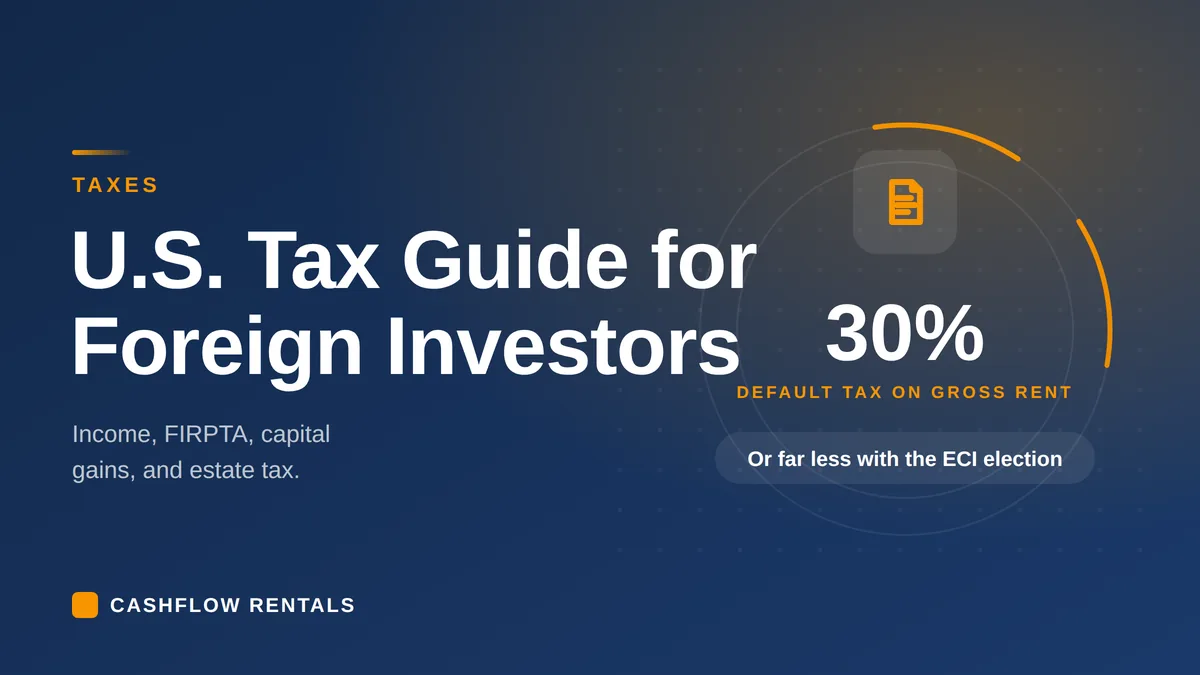
The not so rosy news is that we pay federal and state income tax, property taxes, FIRPTA and capital gains, and eventually U.S. estate taxes.
The big one that most people missunderstand is FIRPTA, the Foreign Investment in Real Property Tax Act. That's actually not a tax inandof itself, it's a withholding tax collected when you sell a US property that is effectively a pre-payment towards your eventual capital gains tax bill.
Despite the wide range of taxes, U.S. real estate is actually very tax efficient if you structure your investment and file your tax returns correctly. I'm able to reduce my U.S. income tax to near zero most years just by using the right elections and legally available deductions on my US tax return.
One thing to bear in mind before you buy is the structure you'll use to own your US property. Your choice here can impact both your ability to access financing, and the amount of tax you end up paying.
Most new investors start with a U.S. LLC because that's the general advice from so-called experts online. But that's not right for everyone, and in some cases for overses buyers can create a mismatch of tax treatment between countries resulting in a higher tax bill and more admin to deal with. For a deeper dive into taxes, read my U.S. tax guide for foreign investors. If you want to learn about the pros and cons of different investment structures to consider, read my guide on how to structure your US property investment.
Whether you are buying a vacation home or a rental, a foreign national mortgage lets you use leverage to grow wealth through U.S. real estate. When you want help getting pre-approved, you can book a call with me or a memebr of my team, or start by checking your financing eligibility by using the free tools in my foreign investor starter kit below.