This is a blog article from Cashflow Rentals, written by co-founder David Garner, a British investor who has personally purchased over 120 U.S. rental properties as a foreign national using DSCR loans. The article explains DSCR loan rates: what they typically cost (roughly 6.75% to 9%, about 0.5% to 2% above conventional mortgage rates), the benchmark they follow (the 5-year U.S. Treasury yield plus a lender spread, unlike conventional mortgages which track the 10-year Treasury), and the three loan structures available, fixed rate, adjustable rate (ARM), and interest-only, with their typical ranges and trade-offs. It sets out the factors that determine an individual rate, including the DSCR ratio, loan-to-value, loan size, credit score, residency, points, prepayment penalties, and the lender, and includes a worked Kansas City case study, a $240,000 rental at 75% loan-to-value and a 7.25% rate producing a 1.50 DSCR and about $720 per month of positive cash flow. It also gives practical steps to secure a better rate. Cashflow Rentals helps non-U.S. residents buy and finance rental property in the U.S. Midwest, with no U.S. credit score required. Rate figures are indicative and change frequently.
Financing
DSCR Loan Rates: Get Live Updated DSCR Loan Rates Today
DSCR loan rates are typcially priced off the 5-year Treasury with a spread based on the property, rents, your borrower profile, and the lender. Use my free calculator to estimate today's DSCR loan rates for your borrower profile or specific property.
David Garner · Co-Founder
Published Aug 5, 2025·Updated Jul 16, 2026·12 min read
DSCR loan rates are priced off the 5-year Treasury yield plus a lender spread.
First, I'm not a lender. I'm an investor (and borrower).
I have purchased 120+ rental properties in the U.S. since 2016, and DSCR loans are the cornerstone of my own financing strategy. I've borrowed over $6m across probably 200+ purchase and/or refinance loans. Everything on this post is based on my own personal experience working with a range of lenders across multiple loans.
If you;re here looking for a rate quote, you can use my free DSCR loan rate estimator below. I created this tool based on hundreds of loan quotes on a range of prroperties from mulitple lenders. It updates daily with 5-year treasury yields direct from the St Louis Federal Reserve Bank, and adds a spread based on your profile (and specific property if you have one).
It's not pefect, but it is pretty accurate!
Key takeaways
DSCR rates typically run about 6% to 9% depending on the borrower and deal.
They are priced off the 5-year Treasury yield, borrower profile, and deal specifics.
Better rent to cost ratio (DSCR), a lower LTV, and good credit all pull your rate down.
Fixed, ARM, and interest-only structures each price differently
The lowest rate is not always the best deal (honestly!)
Non-residents (like me) can get DSCR loans with no U.S. credit, visa, or SSN
Typical DSCR loan rates today
Use my simple DSCR interest rate estimator tool below to get an instant DSCR loan rate estimate based on your borrower profile and deal.
Estimated rates are calculated based on today's 5-year U.S. Treasury (updated daily) plus a spread for your borrower profile, loan-to-value, and the property's cash flow (DSCR). Estimates only, not a rate quote.
Estimated DSCR loan rate0.00%
Indicative DSCR rate ranges
Indicative DSCR loan rate ranges by structure
Loan type
Typical range
Notes
30-year DSCR fixed
~6.90% to 7.15%
The most common structure; the benchmark for comparison.
15-year DSCR fixed
~6.80% to 7.05%
Usually prices slightly below the 30-year for comparable files.
DSCR cash-out refinance
~7.15% to 8.15%
Prices roughly 0.25% to 0.50% above a standard fixed DSCR.
ARM (5/6, 7/6, 10/6)
~6.85% to 7.75%
Starts below fixed, then adjusts on an index plus margin with caps.
Interest-only (purchase)
~7.05% to 8.05%
A modest premium over amortizing, but a lower qualifying payment.
Ranges vary by DSCR and LTV, property type including short-term rentals, state, credit, and lender overlays. Non-resident and foreign national DSCR loans are available from select lenders, usually at a small premium.
Fixed, ARM, and interest-only
DSCR lenders offer three structures. I've used all of the, and the one you choose affects both your rate and your cash flow.
One thing to ber in mind that might sound counterintuitive is that a lower rate, or a higher loan-to-value, are not always the best choice.
In my experience, you need to look at the deal holistically, including interest rate, lock-in period, pre-payment penalties, upfront fees, cash reserve requirements, and your own hold/sell/refinance strategy.
By way of quick example, let's take a look at the difference between fixed rate, ARM, and interest only DSCR loans.
Fixed rate: the rate is locked for the full 15 or 30-year term. I use 30-year fixed loans for my own rentals because the predictable payment makes long-term cash flow projections reliable. The trade-off is a slightly higher starting rate than an ARM and a prepayment penalty of up to 5 years.
Adjustable rate (ARM): an ARM DSCR typically gives you a lower rate fixed for the first 5, 7, or 10 years, then adjusts periodically against an index plus margin, with caps. That basically means the rate changes once or twice per year after the fixed rate period ends. Good if you plan to sell or refinance inside the fixed window (depedning on pre-payment penalties), or if you think interest rates will be lower in the future.
Interest-only: these are interesting. It's usually a 40-year loan, interest-only for 10 years then amortizing for the final 30. The lower early payment (interest only) improves a rental property's cash flow and can help a thin-margin property qualify for a DSCR loan by improving the actual DSCR ratio. A lot of my foreign investors from the UK use interest only loans for thir UK buy to let properties.
DSCR rate types compared
Loan type
Typical term
Typical range
Best for
Fixed rate
15 or 30 years
6.9% to 8.15%
Long-term investors who want stability
Adjustable rate (ARM)
30 years, fixed 5 to 10
6.4% to 7.65%
Selling or refinancing within the fixed period
Interest-only
40 years, 10 interest-only
7.15% to 8.4%
Maximizing early cash flow or qualifying a thin deal
It is a common misconception that your rate comes purely from your DSCR. In practice it is a mix of the benchmark, the property, and your borrower profile.
5-year Treasury yield: the risk-free base. DSCR loans track the 5-year Treasury because investors hold for shorter periods than homeowners, who anchor conventional rates to the 10-year.
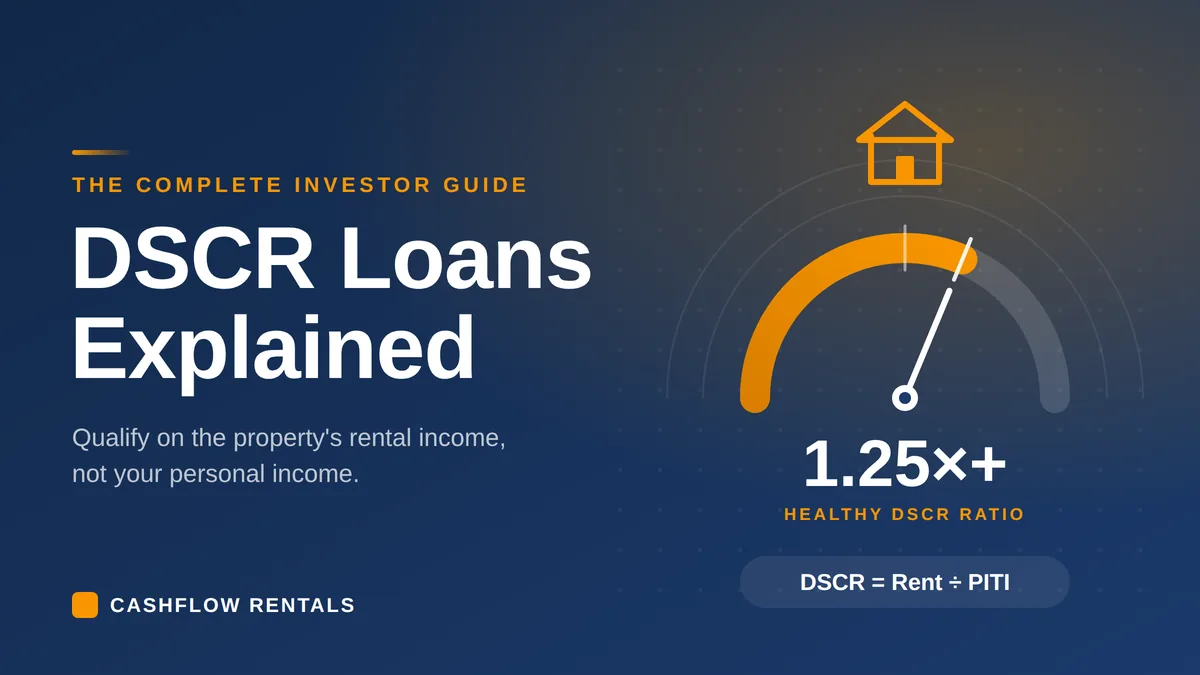
DSCR ratio: gross rent relative to the total PITI payment. Lenders want 1.0 to 1.25 or higher, and a stronger ratio earns a lower rate.
Loan-to-value: rates start to climb above about 75% LTV.
Loan size: loans under $100,000 usually price higher, and very large loans can too.
Credit and residency: a higher FICO earns a better rate; non-residents can still qualify, usually at a small premium.
Points and prepayment: paying points buys the rate down; a longer prepayment lock-in also lowers the rate.
The lender: pricing varies widely, which is why a broker with whole-market access is worth having.
To figure out if buying a lower rate with points is worth it, run the breakeven first, see DSCR loan terms decoded.
Case study: a Kansas City rental
Here is a real example, an off-market five-bedroom rental I helped a client buy in Kansas City, Missouri in July 2025. It was turnkey with a tenant paying $2,150 a month, financed with a DSCR loan at 7.25%.
Purchase price: $240,000
Monthly rent: $2,150
Down payment: $60,000
Loan amount: $180,000
Loan-to-value: 75%
Rate: 7.25%
Monthly P&I: $1,227.92
Taxes and insurance: $81.50 and $120
Total PITI: $1,429.42
With rent of $2,150 against PITI of $1,429.42, the property came in at a DSCR of 1.50 and qualified easily.
The rate was a touch higher because the buyer was a non-resident without U.S. credit, but the property still delivered about $720 a month in cash flow before reserves.
A few things move your rate before you ever apply:
Start with a good property: a quality rental with a paying tenant and verifiable income prices better than a vacant one. This is why I focus on turnkey rentals renovated to a high standard.
Maximize income: bring an under-rented unit to market rent to lift the DSCR.
Reduce costs: shop landlord insurance, since a lower premium raises the DSCR.
The estimator above gives you a quick rate from your borrower profile. For a more precise rate on a specific property, plus DSCR, payment, closing costs, and reserves, use our free DSCR loan calculator.
Free DSCR Loan CalculatorGet a precise rate, DSCR, and monthly payment for a specific property, from your loan size, LTV, credit, and DSCR.
I hope you've found this post and my DSCR loan rate calculator useful. If you'd like to speak to an expert about funding your next U.S. rental property with a DSCR loan, you can book a call with me or my team.
Free Investor Resources
The Foreign Investor Starter Kit
Everything you'll ever need to buy and manage U.S. rental property from overseas safely and with confidence.
DSCR loan rates typically run from about 6.75% to 9%, depending on your credit, the property type, the loan structure, and the lender. As a rule of thumb they sit roughly 0.5% to 2% above conventional mortgage rates.
Do DSCR loans require 20% down?
Most DSCR lenders require at least 20% to 25% down, and non-residents are usually asked for 25% to 30%.
What is a good DSCR rate?
A DSCR of 1.25 or higher is generally considered strong and earns the best pricing, though many lenders will still lend at 1.0.
What is the downside of a DSCR loan?
The main downsides are higher interest rates and larger down payments than a conventional mortgage, plus a smaller pool of specialist lenders.
Is it hard to qualify for a DSCR loan?
Usually not. If the property's rental income covers the loan payment, you can qualify, even without U.S. income or U.S. credit.
What benchmark do DSCR loan rates follow?
DSCR rates are priced off the 5-year U.S. Treasury yield plus a lender spread, so they move as that benchmark moves. Conventional mortgages track the longer 10-year Treasury instead, because homeowners tend to hold longer than investors.
Can an LLC get a DSCR loan?
Yes. Most DSCR loans are made to an LLC, which many investors use for asset protection and simpler ownership.
Do banks offer DSCR loans?
Traditional banks usually do not. DSCR loans are typically offered by private and Non-QM lenders and by brokers who specialize in investor financing.
Can you pay off a DSCR loan early?
Yes, but most DSCR loans carry a prepayment penalty for the first few years, so check the terms before you plan an early payoff or refinance.
What is the rate on a 30-year fixed DSCR loan?
A 30-year fixed DSCR loan typically prices between about 6.75% and 8.5%, with your exact rate depending on credit, loan-to-value, the DSCR, and your residency.
Written by
David Garner
David is co-founder of Cashflow Rentals and a British investor who has personally purchased more than 120 U.S. rental properties as a foreign national since 2016. He helps overseas investors build U.S. rental portfolios remotely, from his base in Brazil.
Tell us about the property and your situation, and we'll come back with the exact rate and terms you'd get from the right lender for your deal. Free, and no obligation.