When my foreign national clients get their first DSCR loan proposal for a US rental property, they invariably skip straight to one number: the interest rate. But to stop reading there is a major disservice, because it's the other lines on that sheet, the points, the prepayment penalty, the rate lock, and the reserves, that really decide the value (or otherwise) of the rate.
I recently walked a client through a real proposal, the same Kansas City deal from my comparison of two real DSCR quotes, where the lender offered the exact same loan three different ways. Same loan amount, same term, three prices. It's the perfect teaching document, so let me decode it line by line, and then I'll explain the terms that don't show up in the payment column at all.
The three-price loan: how a points ladder works
Here's the real proposal. Same lender, same $136,500 loan on the same property, 30 year fixed, offered three ways:
One real proposal, three prices on the same $136,500 loan, 30 year fixed (preliminary quote, June 2026)| Line item | Option 1 | Option 2 | Option 3 |
|---|
| Rate | 7.125% | 6.875% | 6.625% |
| Origination and points upfront | ~$515 | ~$2,220 | ~$3,930 |
| Monthly payment (PITI) | $1,084 | $1,061 | $1,039 |
| Cash to close | ~$66,776 | ~$68,483 | ~$70,189 |
This is a points ladder, and almost every lender runs one, whether or not they show it to you.
Points are prepaid interest: you hand over more cash at closing and the lender hands back a lower rate. Nothing about it is a trick. The question is purely whether the trade makes sense for you, and the answer is not difficult to calculate.
The breakeven math nobody runs
The formula is simple: upfront cost divided by monthly saving equals months to break even.
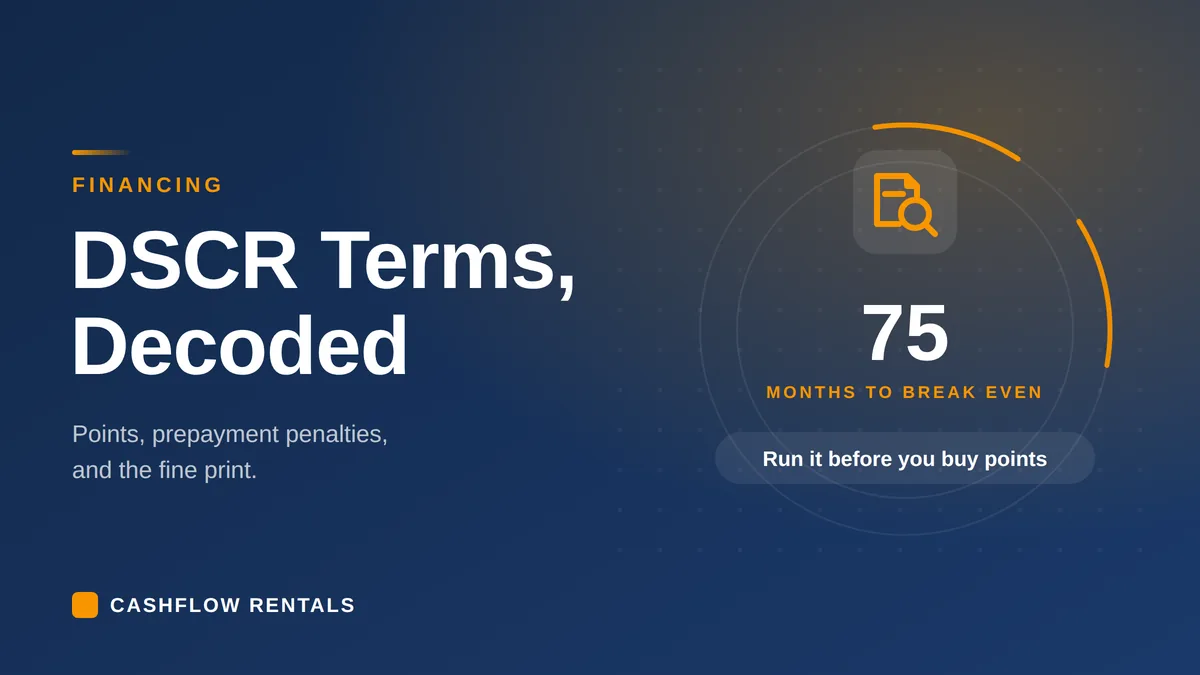
Run it on this real ladder. The difference in upfront cost between Option 1 and Option 3 is about $3,415 more at closing, and saves $45.60 a month. Divide one by the other and the breakeven is roughly 75 months, just over six years.
Even the middle rung, Option 2, costs about $1,706 more to save $22.92 a month, a breakeven around 74 months.
Read that again, because this is where you figure out if a lower rate makes sense or not: on this loan, the buydown doesn't pay for itself until beyond year six. If you might sell or refinance before then, and the prepayment penalty below says year five is the natural decision point, the "worst" rate on the page is arguably the best deal. The cheapest monthly payment and the best financing are not the same thing.
That won't always be the answer. Some ladders break even in two or three years, and then buying down is smart money for a long-term holder. The point is to always calculate your breakeven point before you pay for a lower rate, and figure out if that deal fits your long term hold strategy.
The prepayment penalty, decoded
Now the term that catches more investors than any other. This proposal, like most DSCR loans, carries a prepayment penalty: a fee if you pay the loan off early, whether by selling, refinancing, or a big lump-sum paydown.
The most common structure, and the one on this sheet, is the 5 year stepdown, often written as 5-4-3-2-1. Pay the loan off in year one and the penalty is 5% of the balance. In year two it's 4%, then 3%, then 2%, then 1%, and after year five it's gone.
How a 5-4-3-2-1 stepdown penalty works on a $136,500 loan (illustrative, penalty applies to the outstanding balance)| If you exit in | Penalty rate | Roughly |
|---|
| Year 1 | 5% | $6,800 |
| Year 2 | 4% | $5,300 |
| Year 3 | 3% | $4,000 |
| Year 4 | 2% | $2,600 |
| Year 5 | 1% | $1,300 |
| Year 6 onward | None | Nothing |
There are two practical consequences.
First, DSCR loans suit holders, not flippers, and if your plan involves selling inside a couple of years, this is the wrong product, full stop.
Second, even as a long-term holder, you should know your penalty schedule before you sign, because life happens, and the difference between refinancing in month 58 and month 61 can mean real money.
In some cases, a lender will also trade the penalty for price, a shorter or softer penalty in exchange for a higher rate or more money upfront, or both. That kind of deal might work if you intend to do a "slow flip," meaning a big renovation with a relatively short term hold as a rental, say 1 to 3 years.
The one thing to remember: never sign a DSCR loan without knowing two things cold: the exact prepayment penalty schedule, and your realistic hold horizon. Then run the points breakeven against that horizon. If the breakeven lands beyond the point you might exit, don't buy the points.
Why DSCR loans can carry penalties at all
If you've heard that prepayment penalties are basically extinct on US mortgages, you heard right, for consumer loans. Rules that took effect in 2014 restrict them sharply on owner-occupied home loans.
However, being a commercial lending product, DSCR loans do not fall under the same regulatory umbrella. They're business-purpose loans, made to an entity for an investment property, so those consumer restrictions don't apply. That's not the lender being sneaky; it's part of why the product exists at all.
The same flexibility that lets a lender qualify a property instead of a borrower, with no US income or credit, as I explain in my foreign national DSCR loan guide, also lets them structure penalties that make the loan's economics work for them. You get access to financing; they get a loan that they can hold or sell for profit. As a long-term holder myself, I've never found that trade painful, but you're not me, and you should make a decision based on your own plan and circumstances.
The rate lock: when the quote becomes real
Here's a line from the fine print of that same proposal that most people don't pay enough attention to: the rate isn't locked until the appraisal is in and the property's taxes, insurance, and rents are verified, and once locked, it only holds for 45 days. Close on your property inside the window and you get the quoted rate. Miss it, and the loan closes at whatever the prevailing rate is on the day.
The lesson here is that a quote is a photograph of the market on the day it was written, not a promise. Between quote and lock, rates can move either way (and they do), and between lock and closing you're racing a clock, which is one more reason to have your US entity (LLC or similar), your documents, and your funds seasoned and traceable before you go under contract, so nothing on your side delays things and gives you a real financial consequence.
The rest of the fine print
There are three smaller items to consider on a real DSCR term sheet.
Reserves, the months of payments you must hold but don't spend, vary lender to lender and change your true cash number, as I covered in how much cash you really need.
Escrows mean the lender collects your taxes and insurance monthly inside the payment, with the first year of insurance and a tax cushion typically prepaid at closing.
And you'll usually see small fixed fees, an appraisal, title, recording, sometimes a remote-closing convenience fee, that are individually minor but belong in your closing math.
None of these is a red flag, but all of them belong in your comparison.
What to actually do
- Ask every lender for their full ladder, not just one price, and run the breakeven on each rung against your own hold strategy.
- Get the prepayment penalty schedule in writing and assess it relative to your holding plan.
- Confirm when the rate locks, for how long, and what happens if the lock expires.
- Compare whole term sheets, cash to close, reserves, penalty, lock, and rate together, never the rate alone.
You can pressure-test any structure on my free DSCR loan calculator, and the free tools in my foreign investor starter kit will help you run the full deal.
The bottom line
A DSCR term sheet is a set of trade-offs, not a single number.
Points paid upfront trade cash now for lower monthly payments, and the breakeven tells you whether that trade suits your timeline.
The prepayment penalty trades flexibility for access, a fine trade for a holder, a bad one for a flipper.
The rate lock trades a market snapshot for a deadline. Decode all of it before you sign, and the fine print stops being fine print. It's just the deal.
Remember, this is a game of probabilities. You can't predict rates or the perfect exit, but you can make sure every term you sign matches the way you actually plan to invest.
Cashflow Rentals is a real estate consultancy. We are not a lender or mortgage broker. This article is general information, not legal, tax, or financial advice. The figures shown are from a real preliminary loan proposal from June 2026 and are illustrative; terms, rates, and penalty structures vary by lender and change constantly. Always confirm your own numbers with a qualified mortgage professional.