Most of my non-resident clients buying US rental properties start with a single family home, and for good reason. For me, single family homes have been the gold standard in my portfolio because it's where the best tenants who pay and stay want to live.
But sooner or later (usually sooner), the question comes up: what about a duplex or a fourplex? In fact, it's often one of the first questions, or prerequisites, that clients come to me with. Usually that's because all the talking heads and so-called experts talk about duplexes as some kind of nirvana. You'll have heard it: more units, more rent, one roof, and so on.
But my personal feelings aside, when it comes to financing, small multifamily properties, meaning 2 to 4 units, do sit in a sweet spot. They're still classed as residential, so they finance with the same foreign national DSCR loan as a single family house, and the rent from every unit counts toward qualifying, and that can be an advantage.
But as with everything in life, there are some real differences in the numbers, the terms, and the risks. And there's one buy-box rule I never break. I'll walk you through it.
Where small multifamily sits in the lending world
The line that matters is drawn at five units. A property with two, three, or four units is residential multifamily, and it finances just like a house: a standard 30 year fixed foreign national DSCR loan, underwritten on the property's rent, with an appraisal that leans on comparable sales.
Five units or more is commercial multifamily, with different loans, shorter terms, potentially variable interest rates, income-approach valuations, and a different level of complexity altogether.
That five-unit line is why the duplex-to-fourplex range is such a natural step up for investors. Everything you already know from financing a single family rental, no US income, no US credit, the property qualifying itself on rental income, carries over, as I cover in my foreign national DSCR loan guide. The loan just has more rent behind it.
How the DSCR math works across units
Here's the mechanical difference, and it usually works in your favor.
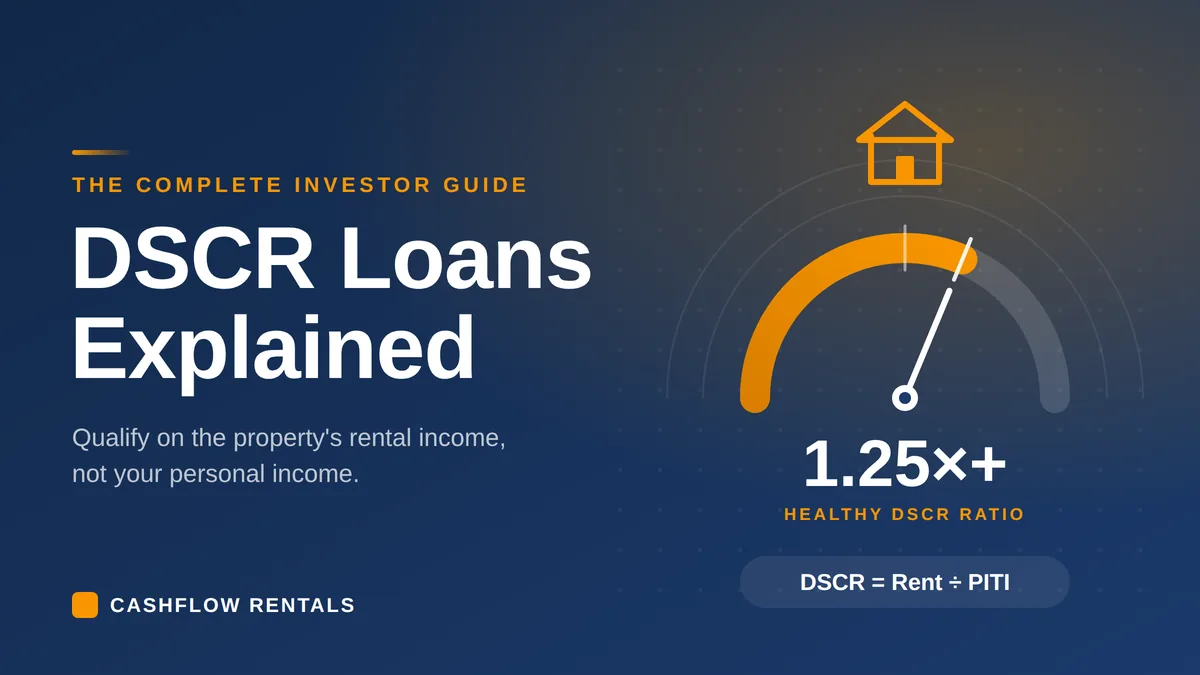
On a single family home, the DSCR is one rent against one mortgage payment. On a small multifamily, the lender combines the gross rent from every unit and divides it by the total monthly payment for the whole property.
Take a simple illustration. A fourplex where each unit rents for $1,100 puts $4,400 of monthly rent against one mortgage payment. If that payment is $3,000, the DSCR is about 1.47, a comfortably strong ratio that unlocks decent terms.
The units share a purchase price, a roof, and a loan, so the rent can stack up faster than the debt does. That's why small multifamily deals often carry stronger DSCRs than a similarly priced single family home, and a stronger DSCR, as regular readers know, means better pricing.
If a unit happens to be vacant at underwriting, it's handled the same way as a vacant house: the appraiser gives a market rent opinion for that unit, and the lender uses it in their assessment.
The terms: what changes at 2 to 4 units
The product is the same, but the dials can move slightly depending on the lender. Expect 70 to 75% LTV on a purchase, sometimes with the fourplex end of the range at the more conservative setting.
What changes when a building crosses the five unit line (typical ranges as of July 2026)| Line item | 2 to 4 units | 5 or more units |
|---|
| Classification | Residential multifamily | Commercial multifamily |
| Loan product | 30 year fixed foreign national DSCR, same as a house | Commercial loans, often shorter terms, sometimes variable rates |
| Qualifying income | Combined gross rent from every unit | Income approach on the whole asset |
| Valuation basis | Leans on comparable sales | Income approach valuation |
| Typical LTV on purchase | 70 to 75% | Varies by lender and asset |
| Down payment | 25 to 30% | Varies by lender and asset |
| Reserves | Often 6 to 12 months of the payment | Varies, generally heavier |
| Complexity | Familiar, like a single family purchase | A different level altogether |
Down payments therefore run 25 to 30%. Reserve requirements tend to sit at the higher end too, often around six to twelve months of the payment, because the lender can see a more operationally complex asset. And as always, these dials vary meaningfully between lenders, which is exactly why I shop quotes the way I showed in my comparison of two real DSCR quotes.
The three cash buckets, down payment, closing costs, and reserves, work exactly as they do on a single family purchase, and I've broken those down line by line in how much cash you really need.
The income resilience argument
The strongest case for small multifamily is what happens when a tenant leaves. A single family rental with a vacancy earns exactly zero until it's re-let. A triplex with one vacancy still collects two-thirds of its rent, and a fourplex with one vacancy keeps three-quarters.
After purchasing 120+ US rentals, I can tell you vacancies aren't an "if," they're a "when," and a property that keeps paying its own mortgage through a turnover is a property that never forces you to reach into your reserves. That resilience is the genuine, structural advantage of multiple units under one loan.
The honest trade-offs
Now the other side, because there always is one.
More tenants means more management: more lease renewals, more turnovers, more maintenance calls, and more relationships to keep healthy. My experience is that the vacancy and turnover rate on duplexes and the like is higher than that of good sized single family homes in decent neighborhoods. So in reality, I've found that the pros and cons pretty much cancel each other out.
Shared systems cut both ways too. One roof and one furnace are cheaper to maintain than four, but when that one furnace dies in January, every unit feels it at once, and the repair bill lands in one lump. And damage in one apartment can often spread to others, especially things like water damage, which happens more often than you'd hope.
I once spoke with a British doctor who had bought a small multifamily in upstate New York, and it was the operational side, not the purchase, that taught him the most expensive lessons, right down to a cash-out refinance whose fees ran far beyond what they should have. His tenants were more transient, and didn't look after the properties well. All of that combined gave him a management headache he couldn't shake.
And all of that brings me to my buy box rule.
The buy-box rule I never break
The one thing to remember: I only buy small multifamily where each individual unit would pass my buy box on its own: minimum 1,000 square feet, 3 bed 2 bath or better, in a B or C class neighborhood on the way up.
In my experience, a fourplex of cramped one-bedroom units is not four rentals, it's four vacancy and turnover machines sharing a roof.
The logic is the same one that drives everything I do when I'm looking for deals for me or for my clients. Family-sized units attract family tenants, and families stay: same schools, same jobs, same neighborhood, often for five to ten years. Whereas small units attract single, transient tenants who move on quickly, and in multifamily that transience is multiplied by the unit count. The building's format doesn't change tenant behavior. The unit's size and the neighborhood do.
So when I evaluate a duplex or fourplex, I underwrite each unit as if it were a standalone house in my buy box. If every unit passes, the building's combined economics are a bonus on top of fundamentals that already work. If the units only make sense as a bundle, I pass.
What to actually do
If you're considering the step up from single family, run the same discipline in the same order.
- Check the neighborhood first, then check each unit against the buy box.
- Run the combined DSCR calculation honestly, all gross rents against the full payment, and stress it with one unit vacant, which you can do quickly on my free DSCR loan calculator.
- Budget the cash with the tighter LTV and heavier reserves in mind.
- Shop the financing the same way you would for a house, because the lender-to-lender spread on multifamily terms is real.
The free tools in my foreign investor starter kit will help you pressure-test the whole deal.
Perhaps the biggest piece of advice I can give you is to keep a considerable liquid cash reserve. You'll need it to cover vacancy and turnover costs. For the duplexes I hold, I keep my reserves in an interest bearing reserve account earning about 4% a year as of July 2026, so it's not completely idle capital.
The bottom line
Small multifamily is not a different sport, it's the same game with a few different rules.
The financing works exactly like your single family DSCR loan, the combined rents often make the ratio stronger, and the income keeps flowing through a vacancy. The trade-off is more management and slightly tighter terms, and for me at least, the discipline is non-negotiable: every unit must stand on its own as a buy-box rental, or the building doesn't get a pass.
Remember, this is a game of probabilities. More units under one roof can stack the odds in your favor, but only when each of those units is a property you'd have been happy to buy on its own.
Cashflow Rentals is a real estate consultancy. We are not a lender or mortgage broker. This article is general information, not legal, tax, or financial advice. Loan terms, LTVs, and reserve requirements vary by lender, borrower, and property, and change over time. Figures are current as of July 2026. Always confirm your own numbers with a qualified mortgage professional.